
The IT service management market changed in late 2025 when ServiceNow completed its acquisition of Moveworks. ServiceNow announced the deal on 10 March 2025 at $2.85 billion in cash and stock, and closed it on 15 December 2025.
ServiceNow says Moveworks continues to be offered as a standalone product. Buyers on other ITSM platforms may still want to compare their options.
If you are evaluating AI for IT service management, our guide to what is hype and what is deployable in AI for ITSM is a useful companion to this list.
This guide covers seven options: six alternatives to Moveworks, plus ImmutIQ, our own early-access product, which is listed for transparency.
Each profile below separates what the vendor says about itself from what its public pages document. Prices appear only where the vendor publishes them, and vendor figures are labelled as the vendor’s.
Understanding the Moveworks Shift
This section covers what Moveworks is and what changed with the ServiceNow deal.
What Moveworks Is
Moveworks describes itself as an AI assistant platform for searching and acting across business applications. It says it serves more than 350 organizations and lists eight weeks as its typical time to value. These are the vendor’s figures.
Moveworks lists integrations with Slack and Microsoft Teams, and with ITSM systems including ServiceNow, Jira, Freshservice, BMC Helix, Ivanti Service Desk and ManageEngine, on its own site.
Points to Weigh When Comparing Alternatives
Points to weigh if you are comparing options:
- Ownership: Moveworks is now part of ServiceNow, which says it continues to offer Moveworks as a standalone product.
- Pricing: Moveworks’s pricing page is a custom quote request form with no figures.
- Scope: Moveworks lists integrations with ITSM systems. Atomicwork, Aisera and Siit each describe their own service desk products.
1. Aisera: AI Service Desk Now Part of Automation Anywhere
Aisera is now part of Automation Anywhere, which completed the acquisition on 4 November 2025. Automation Anywhere says the product continues without disruption and describes it as an AI-native enterprise service management platform.
What Aisera lists
Resolution
Aisera says its domain-specific AI agents auto-resolve requests and incidents. Automation Anywhere’s Aisera page lists an 80 percent auto-resolution rate for the IT service desk and 84 percent for ITSM. These are the vendor’s figures and are not independently verified.
Incident detection
Automation Anywhere’s AIOps page says the platform can detect and prevent incidents up to 48 hours before they occur (a vendor claim).
2. Atomicwork: ITSM Platform and AI Workforce
Atomicwork describes itself as the AI-native ITSM and ESM platform, run by AI Coworkers and governed by your IT team. It has its own ticketing, and its site says the AI workforce can also run on top of ServiceNow or Jira Service Management.
Its Universal AI Coworker works in Slack and Microsoft Teams, and the site also lists email, a browser and a web portal.
What Atomicwork lists
Input and languages
Atomicwork lists chat, voice and vision support, in 25 or more languages.
Where it works
Atomicwork says employees get help in the tools where they already work.
Industry Research
Atomicwork’s State of AI in IT 2026 report, based on 1,000 or more IT professionals and users, says 98 percent of organizations are already using or planning AI projects and 67 percent report positive ROI. This is research published by the vendor.
Case study and pricing
Atomicwork’s Pepper Money case study says four weeks from contract to production, while its homepage says Pepper Money replaced ServiceNow in six weeks. Both figures come from the vendor. Pricing: on its usage-based tab, the Professional plan starts from $25,000 a year, billed annually, with 25,000 credits, 2 AI Coworkers and up to 250 end users; Business and Enterprise are custom (read 14 November 2026).
3. Leena AI: Voice-Enabled AI Assistant for IT, HR and Finance
Leena AI says its AI colleagues are voice-enabled, available around the clock and fluent in 100 or more languages, and that they cover IT, HR and finance.
How Leena AI works with your ITSM tool
Leena AI’s IT page says the assistant raises incidents and catalog requests, tracks them and answers from the knowledge base, and resolves requests on Slack and Teams.
What Leena AI says about results
Leena AI says 70 percent or more of tickets are auto-resolved, and that customers go live in 45 days. These are the vendor’s claims.
Integrations and pricing
Leena AI says it has 200 or more pre-built connectors, and its pricing page names Workday, ServiceNow and SAP. It publishes no prices. Its pricing page says the Universal Assistant is a flat licence per employee per year and the AI Colleagues Platform is a platform fee plus usage billed in tokens.
4. Risotto: AI IT Help Desk and Ticketing
Risotto lists tier 1 support, a Tier 2 assistant, access management, workflow runbooks, knowledge management and ticketing for several departments, according to its site.
Results and escalation
Risotto says it can automate up to 60 percent of internal tickets (a vendor claim) and escalates the rest to your team with the full conversation and a proposed solution.
Integration
Risotto works in Slack and email, and sits on top of ticketing tools such as Jira, Freshservice or Zendesk, or you can use its own ITSM, according to its pricing page. Its Startup plan, for companies under 200 employees, is $1,250 a month paid annually; Enterprise is custom (read 14 November 2026).
5. Siit: AI Service Desk Priced Per Admin
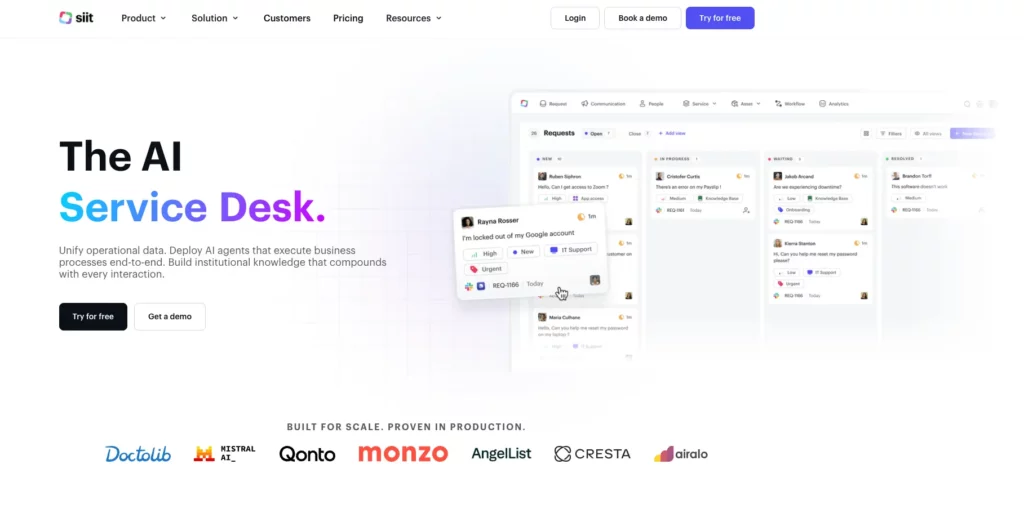
Siit describes itself as the AI service desk for IT and internal operations, covering IT, HR, Finance and other teams.
Data and context
Siit says it gives one context for every request: people, equipment, apps and knowledge drawn from your HRIS, MDM, identity provider and knowledge base.
Channels
Siit lists Slack and Microsoft Teams bots, and says it works directly in both.
Pricing
Per-admin seat pricing: Siit is priced per admin rather than per employee, and supports unlimited employees. The plans are Essentials at $23, Standard at $45 and Pro at $89 per admin per month, billed annually, plus a custom tier (read 14 November 2026).
Siit says its price does not rise with employee headcount.
Workflows
Siit lists workflows across IT, HR, Finance and other internal systems, and its pricing page lists automated workflows from the Standard plan.
Integrations
Siit’s homepage says it connects to more than 500 tools, including identity providers, HRIS systems and device management tools.
6. Rezolve.ai: AI Service Desk for Teams, Slack and Chat
Rezolve.ai’s Sidekick lets employees get IT help in Microsoft Teams, Slack, email, web and phone, according to its site. Its site also describes a system of record for ITSM and lists ServiceNow among the systems it works with.
Microsoft Teams support
Rezolve.ai says its Sidekick works inside Teams, and names a credit union with more than 312,000 members as a Teams-supported example.
Pricing
Rezolve.ai says “you pay for people, not usage”: pricing is per employee per month and per fulfiller per month, with no per-resolution fees and no token charges on the core platform. No dollar amounts are public.
Integrations
Its site lists out-of-the-box Model Context Protocol servers for incident, problem, change, major-incident and asset management.
Customers
Rezolve.ai’s site lists credit unions and banks, higher education, and state and local government among the industries it serves, and shows healthcare examples.
7. ImmutIQ: Our Own Product (Early Access)
ImmutIQ is the company behind this site, so this entry is listed for transparency and is not a recommendation. Its assistant is in early access with a waitlist. Its homepage describes intelligent ticket routing, automated incident resolution and AI-driven insights for IT service management.
On its homepage, ImmutIQ lists no pricing, integrations or customers yet, so it cannot be compared with the other entries on features or cost. You can join the waitlist to follow its progress.
Moveworks vs Jira Service Management: Understanding Two Different Approaches
Jira Service Management is Atlassian’s ITSM product. Atlassian’s Service Collection pricing page lists it together with Assets and Rovo, and lists a virtual service agent on the Premium plan.
Moveworks lists Jira among its integrations, so the two can be used together. Atomicwork says its AI workforce can run on top of ServiceNow or Jira Service Management, and Risotto says it can augment Jira, Freshservice or Zendesk.
If you run Jira Service Management, the practical question is whether you need an AI layer on top of it or an ITSM platform with AI built in. Check what Atlassian’s virtual service agent covers before you add another product.
Choosing the Right Platform for Your Organization
Use these questions to compare the options above.
Key Evaluation Questions
1. What is your organization’s AI maturity level?
- Which requests can the AI complete itself today, and which does it hand to a person?
2. Where do your employees actually work?
- Does the vendor list your chat tool, Teams or Slack, on its own site, and how does an employee raise a request there?
3. What is your true scope of need?
- Do you need IT only, or HR, finance and facilities too? Compare each vendor’s listed use cases.
4. How does your organization prefer to implement new technology?
- How long does the vendor say go-live takes, and is that the vendor’s claim or a customer’s account?
5. What is your budget reality and how do you want to scale costs?
- What does the price depend on: admins, employees, credits or resolutions? Ask each vendor for a quote for your own headcount.
Summary
ServiceNow’s Moveworks deal closed on 15 December 2025, and Moveworks remains available as a standalone product. The options above differ in whether they are a service desk or an AI layer, which chat tools they list, and how they charge. Compare them on those three points and ask each vendor for a quote for your own headcount.
- ServiceNow alternatives: 9 tools compared on price, AI and fit
- AI in ITSM: what is hype and what is deployable: which AI claims hold up
- Is a password reset an incident or a service request?: a practical ITIL 2 to ITIL 4 analysis